
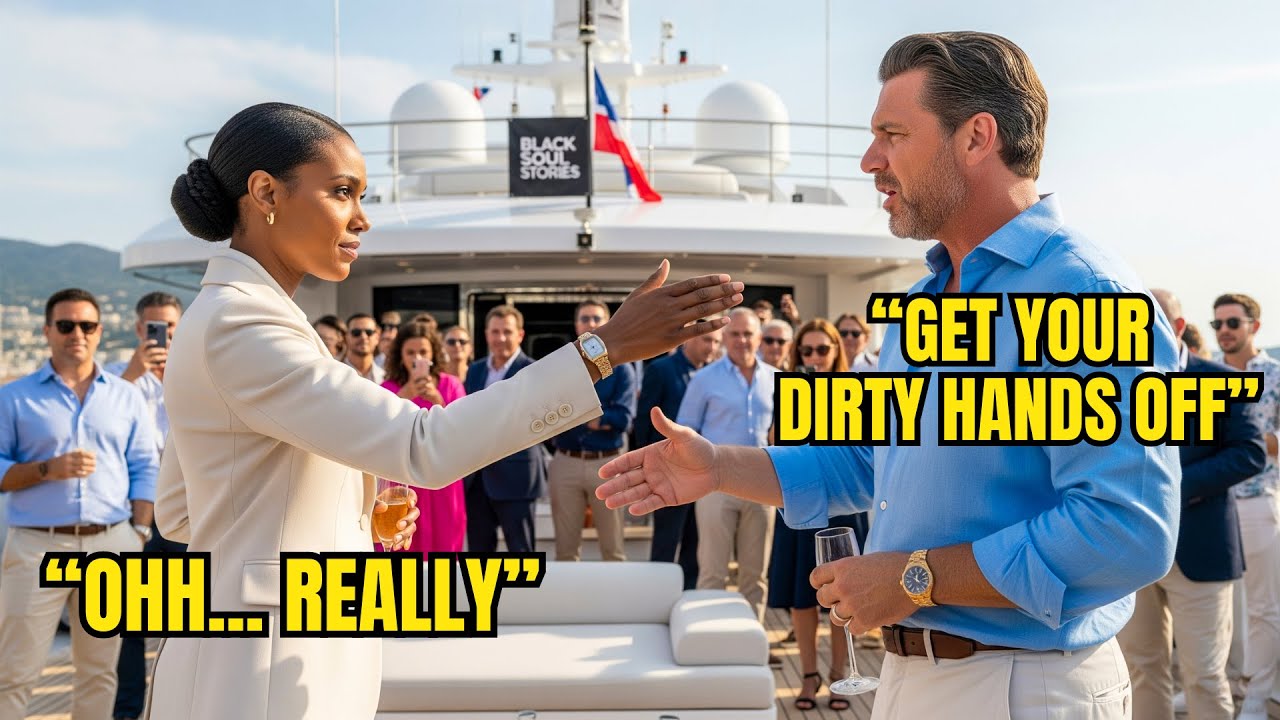
The handshake hung in the air for exactly 3 seconds. Then billionaire Marcus Whitfield jerked back like he’d touched poison. I don’t shake hands with staff. His voice cut across the yacht’s deck. 200 investors froze. Three phones were recording. The black woman’s hand remained steady, professional, unbothered.
Discover more
US historical fiction
German language courses
Online news portal
Security. Whitfield’s bark shattered the Mediterranean silence. How did catering staff get on the main deck? Dr. Amara Williams watched billionaires scramble backward, creating a perfect circle around her. The $80 million yacht Dominion suddenly felt very small. Tech mogul whispered. Cameras captured everything.
Someone laughed. A sharp ugly sound. These are the moments that birth the most powerful black stories. When arrogance meets its match. Real life stories where everything changes in heartbeats. Touching stories of quiet revolution. Have you ever stood completely alone while a crowd decided you didn’t belong? When you held power they couldn’t see, couldn’t imagine, couldn’t survive without? The word security ricocheted across the deck like a slap.
Rodriguez materialized instantly. 6’4 of ex-Navy muscle who solved problems quietly. Ma’am, I’ll need your credentials. His tone carried professional courtesy laced with suspicion, the kind reserved for people who didn’t belong in places like this. Amara reached into her blazer with surgical calm. The digital countdown above the main stage pulsed red, keynote 10 minutes.
She produced a holographic speaker badge, pristine white with security strips that caught the Mediterranean light. Rodriguez examined it like a detective studying evidence, turning it over, holding it up, searching for flaws that would justify what everyone already believed. Badges can be replicated, Whitfield announced to his audience of 200.
Discover more
Military history content
Suburb design books
American suburb tours
Happened at Davos. Woman claimed to be a hedge fund manager. Turned out she cleaned offices. The nervous laughter that followed felt rehearsed, practiced, the sound wealthy people make when they’re reminded why gates exist. Someone whispered, “Always the ambitious ones.” And heads nodded in that particular way that transforms individual prejudice into group consensus.
Tech blogger Sarah Morgan angled her phone subtly, live streaming to 2,300 Tik Tok followers as the view count climbed steadily. Summit organizer David Anderson appeared at Whitfield’s elbow, face flushed with escalating panic. Marcus, we have a serious situation with the keynote speaker, but Whitfield cut him off with a dismissive wave. Handle this first. Bad optics.
My investors don’t need distractions from people who can’t follow basic protocols. Chen’s tablet showed 8 minutes remaining. As Amara’s phone buzzed with an incoming call, the caller ID flashed briefly. Goldman Sachs, private wealth, before she declined without glancing at it. Her Hermes handbag, understated, elegant, worth more than most annual salaries, rested against her hip, while a corner of what appeared to be a first class boarding pass protruded from the side pocket like a small flag of contradiction. “Ma’am, I need you to
come with me while we verify your authorization to be here.” Rodriguez continued, his training taking over even as something nagged at him about her complete lack of fear. The crowd pressed closer, forming a human coliseum around this unexpected entertainment. Phones emerging like flowers turning toward sun.
Verify what exactly? Amara’s voice carried a strange quality. Not defensive, not angry, but almost amused, like someone watching a play where only she knew the ending. that I belong here. The question hung in the salt air while Witfield stepped forward, energized by his audience’s attention. That you’re supposed to be here, he clarified, gesturing broadly to encompass his domain.
I’ve built three unicorn companies, Techflow, Datava, Cloudbridge. Combined valuation $12 billion. I know exactly who belongs at these summits and who’s trying to crash them for networking opportunities. The crowd murmured approval, a Greek chorus of validation for their gatekeeper. Amara checked her watch, a PC Philippe nautilus that caught light like captured starfire, and said, “Impressive portfolio.
What’s your exit strategy for Techflow’s current burn rate situation?” The specificity of her question created a hairline crack in Whitfield’s confidence, quickly plastered over with bluster. Lucky guess. Information’s available if you know where to look online. But senior VP James Thompson had materialized beside them, and his corporate instincts were screaming warnings.
Something about her posture, her clothes, the way she wasn’t sweating despite being the center of systematic humiliation. “Marcus, what’s the actual situation here? We’re supposed to be live in uninvited guest scenario,” Whitfield explained without lowering his voice, playing to the crowd. Security oversight at the gang way. We’ll sort it quickly.
Sarah Morgan’s live stream had exploded to 8,700 viewers as chat erupted. This is insane. Recording everything. She’s way too calm. Someone’s about to learn something expensive. Amara’s phone buzzed again, the preview text visible to anyone looking. Doctor Williams, the board is waiting for your before cutting off.
Whitfield caught the doctor designation but dismissed it. Fake credentials were easier to buy than real ones. Thompson, however, felt ice forming in his stomach as pieces began assembling into a picture he desperately didn’t want to see. Ma’am, Thompson attempted diplomacy. Perhaps there’s been a scheduling confusion.
If you could just step aside while we verify. But Amara was already pulling out her business card, pristine white with embossed lettering that caught light like a blade. She extended it toward Whitfield with the patience of someone who had learned to let other people create their own disasters. He waved it away without looking.
I don’t need your catering company’s card. The countdown hit 5 minutes as Anderson’s panic reached visible levels. Marcus, I really need to discuss the keynote speaker situation immediately. There’s been a after we resolve this disruption, Whitfield snapped, then addressed his audience again. Ladies and gentlemen, I apologize for this interruption.
Sometimes people get ambitious about networking access, but protocols exist for everyone’s protection. The scattered applause felt like validation, like democracy, like the natural order reasserting itself against chaos. The business card fluttered to the deck, caught by Mediterranean wind, but Thompson’s instincts made him step on it before it could escape.
When he glanced down, his world tilted sideways. The embossed text read, “Dr. Amara Williams, managing partner, Zenith Capital Management.” Thompson’s throat constricted as recognition hit like ice water. Zenith Capital. Every serious investor knew that name, feared that power, courted that influence.
“Marcus,” he whispered urgently, tugging at Whitfield’s sleeve like a drowning man. But Whitfield was riding the crowd’s energy now, feeding off their collective certainty. “Security protocols protect everyone. We can’t have random people disrupting.” “She’s not random,” Thompson hissed desperately. But Whitfield gestured to Rodriguez anyway.
Please escort this woman to staff quarters. We’ll sort everything out after the presentation. Rodriguez approached with zip tie restraints, standard protocol for potential security threats. As the countdown blinked 3 minutes, and Sarah Morgan’s stream exploded past 15,000 viewers, Amara opened her laptop with the calm of someone who had waited long enough.
The laptop screen glowed like a portal to another world. As 15,000 people watched through Sarah Morgan’s live stream, Amara’s fingers moved across keys with surgical precision, but she angled the screen away from prying eyes, creating a mystery that made the crowd lean forward collectively like flowers seeking light. “Ma’am, unauthorized devices must be secured immediately,” Rodriguez commanded his Navy training screaming warnings about potential corporate espionage.
Every protocol demanded he confiscate that laptop, but something about her absolute calm was shortcircuiting his instincts. Criminals panicked. Terrorists sweated. This woman typed emails like she was ordering coffee. Whitfield’s confidence flickered momentarily as he registered her impossible composure. Every gate crasher he’d encountered before had crumbled under public pressure, apologized, retreated with dignity intact.
This one was conducting business like she owned the yacht. Security protocols exist for everyone’s protection, he announced to his audience, voice pitched to reach the back rows. Corporate espionage attempts have become increasingly sophisticated. Thompson clutched that business card like evidence of incoming apocalypse. Something about the company name triggering half-remembered warnings.
But Whitfield was performing now, drunk on crowd validation, deaf to anything except applause. Marcus, you absolutely must examine this identification before. After we neutralize the immediate security risk, Whitfield cut him off, gesturing broadly to encompass his kingdom of spectators. Everyone present can witness proper protocol enforcement.
The countdown hit 2 minutes as Anderson materialized at the crowd’s edge, face sheet white with escalating panic, tablet clutched against his chest like protective armor. Sarah Morgan’s chat exploded with real-time theories. She’s way too calm. This feels orchestrated. Why won’t anyone look at her card? Something massive is coming.
The viewer count climbed past 22,000 as Yachtgate viral spread across Twitter. Screenshots flooding Instagram stories and LinkedIn posts. Final compliance warning. Rodriguez moved closer, zip ties reflecting Mediterranean sunlight like handcuffs. Device closure. Hands visible. Immediate cooperation required.
His voice carried decades of unquestioned authority. But Amara’s typing actually accelerated, fingers dancing across keys like a concert pianist approaching crescendo. The laptop’s cooling fan hummed harder, processing something significant. Morrison, a venture capitalist with four decades of reading power dynamics, whispered to his neighbor with growing unease.
Her body language is all wrong for someone caught crashing. She’s acting like someone who belongs here more than we do.” His observation rippled through nearby spectators like dropped stones in still water, planting doubt seeds in previously certain minds. But Whitfield intercepted the murmur and amplified his performance accordingly, conducting his orchestra of privilege with masterful precision.
Ladies and gentlemen, this situation perfectly illustrates why exclusivity serves everyone’s interests. Proper vetting protects our investments, our time, our collective security. He paused for maximum dramatic impact, letting righteousness settle over the crowd like expensive perfume. We’ve earned our positions through decades of building, creating, revolutionizing entire industries.
The applause thundered across the deck, moral authority tasting delicious when collectively consumed. Someone shouted, “Just remove her already.” And others joined enthusiastically, individual discomfort crystallizing into group righteousness through Whitfield’s expert manipulation. The mob was forming organically, naturally, beautifully.
Chen forced his way through the human barricade, desperation visible in every line of his body. Marcus, we have an escalating crisis that demands immediate attention. But Whitfield silenced him with an imperious gesture, completely absorbed in his role as defender of proper social order. David, whatever minor administrative confusion you’re managing can wait precisely 90 seconds while we resolve this security breach.
A new player entered the arena. Dr. Elizabeth Hartwell, Whitfield’s board adviser, emerged from the yacht’s interior with phone pressed to her ear. She caught sight of the commotion and froze, her conversation forgotten. Something about the scene triggered alarm bells in her lawyer’s mind. Too many cameras, too much documentation, too much potential liability.
Thompson was vibrating with barely contained panic now. The business card burning in his palm like radioactive material. Every corporate instinct developed through decades of hostile takeovers and boardroom warfare screamed that they were sleepwalking into catastrophe. But crowd noise was drowning his warnings like tsunami waves against seaw walls.
Four more phones emerged from the audience as a Bloomberg reporter started live tweeting updates. Her follower count exploding as the story gained momentum. The circular amphitheater now encompassed the yacht’s entire social deck. Phones raised like digital torches demanding justice, validation, entertainment.
Amara’s laptop chimed softly, a single notification that cut through crowd noise like a funeral bell. She typed for exactly 12 more seconds, then stopped completely. The sudden absence of keyboard clicking felt louder than thunder, pregnant with implications nobody could comprehend yet, but everyone could sense approaching like distant lightning. Dr.
Hartwell approached the circle’s perimeter, her legal radar pinging frantically. Marcus, what exactly is happening here? But her voice was lost in the crowd’s energy, their collective certainty drowning individual concerns like ocean waves against individual stones. The countdown hit 75 seconds as Rodriguez reached for Amara’s laptop, but she finally looked up with laser focus that made several spectators unconsciously step backward.
Mr. Whitfield, before security confiscates my equipment, you might want to know what I just documented. I don’t care about your social media conspiracy theories,” Whitfield replied. But something in her tone was making his wealthy skin crawl with unfamiliar sensations. The absolute confidence radiating from someone who should have been humiliated, terrified, begging forgiveness.
Instead, she seemed almost satisfied. “Not social media,” Amara said with silk wrapped steel legal documentation for compliance purposes. She closed the laptop with a sound like a vault door ceiling shut. My firm takes discrimination incidents extremely seriously, especially when they’re witnessed by thousands of people and recorded from multiple angles.
Doctor Hartwell’s phone slipped from nerveless fingers as that word firm triggered recognition cascades in her legal mind. firms meant law firms or investment firms, both categories that could destroy companies like Techflow without breaking stride. “Marcus,” she called urgently, pushing through the crowd.
“You need to stop this immediately.” But Thompson finally reached his breaking point. Corporate survival instincts overriding every social constraint. “Marcus, look at the goddamn business card.” His voice cracked across the deck like thunder, freezing every conversation midsllable. Before you destroy everything we’ve built, the crowd turned as one organism toward Thompson, sensing climax approaching, but unable to predict its shape.
Sarah Morgan’s live stream exploded past 35,000 viewers as chat erupted in digital chaos. Something’s happening. Look at their faces. This is getting nuclear. The viral momentum was unstoppable now. Links spreading across platforms like wildfire. Chen chose that moment to add gasoline to the flames.
The keynote speaker still hasn’t arrived and we go live in 60 seconds. His panic was contagious, spreading through the crowd like recognition that something fundamental was breaking down in real time. Amara stood slowly, laptop tucked under her arm like unexloded ordinance. 60 seconds remaining. Mr. Whitfield. Shall we continue this performance for your audience, or would you prefer to discuss business privately before your company’s future becomes everyone’s entertainment? The business card trembled in Thompson’s outstretched hand like a white flag of
surrender. Whitfield glanced at it dismissively, his brain still locked in performance mode, unable to process warnings that contradicted his carefully constructed narrative. Whatever fake credentials she’s printed won’t change the fact that she crashed. Zenith Capital Management, Thompson read aloud, his voice cracking like breaking glass.
Dr. Amara Williams, managing partner. The words hit the crowd like concussion grenades detonating in sequence. Venture capitalists went rigid as marble statues. CEOs stopped breathing entirely. Anyone with serious money in tech knew that name, feared that influence, had either courted or been destroyed by decisions made in Zenith Capital’s Manhattan boardrooms.
Morrison grabbed his neighbor’s arm hard enough to leave bruises. Zenith Capital manages 47 billion in assets, he whispered with the reverence reserved for discussing gods. They’ve funded half the unicorns in Silicon Valley. They can make companies disappear with phone calls. Sarah Morgan’s live stream exploded past 40,000 viewers as chat erupted in real-time shock.
Holy [ __ ] Zenith Capital. He’s so [ __ ] dead. Career suicide live on Tik Tok. Someone saved this video. The viral momentum was unstoppable now. Screenshots flooding every social platform as people sensed they were witnessing business school case study material being born in real time. But Whitfield’s mind was still struggling to reconcile contradictory realities.
The woman he’d dismissed as catering staff couldn’t possibly be one of the most powerful investment partners in America. Cognitive dissonance created its own gravity field, bending logic around what he needed to believe. Zenith Capital’s partners don’t just show up unannounced at industry summits. They send representatives, advanced teams, proper protocols.
Texas travel guides
You mean like keynote speakers? Amara asked softly, opening her laptop again. The screen illuminated her face with blue light that made her look ethereal, otherworldly, dangerous. Tell me, Mr. Whitfield, what do you know about Techflow’s current financial position? The question hung in Mediterranean air like a blade suspended over his throat.
Whitfield’s mouth went desert dry as implications began penetrating his shock. Tech flow was bleeding money faster than oil from a ruptured tanker. Their burn rate was unsustainable without major investment without the deal they’d been negotiating with. No, he whispered, the word barely audible over wind and waves. Dr.
Hartwell had reached the circle’s inner edge, her lawyer’s mind processing the catastrophe with crystallin clarity. Marcus, stop talking immediately, she commanded with courtroom authority. Do not say another word until we can assess legal exposure. But Anderson exploded into the moment like a man whose house was burning.
She is the keynote speaker. Dr. Amara Williams was supposed to announce Zenith Capital’s investment in Techflow, the largest single funding round in our company’s history. His words tumbled out like water through a shattered dam. $2.1 billion. The deal that was going to make us the dominant force in enterprise cloud computing.
The silence that followed was so absolute that seagulls crying overhead sounded like air raid sirens. Every phone camera captured Whitfield’s face as understanding finally dawned. The slow motion car crash of a man realizing he’d just incinerated his own company while hundreds of witnesses documented every microsecond.
Rodriguez had frozen completely, his hand still extended toward Amara’s laptop like he was afraid it might explode. Security protocols hadn’t prepared him for situations where the threat controlled more wealth than most nations GDP. “Sir,” he said to Whitfield, uncertainty fracturing his voice for the first time in decades.
“What are your instructions?” “Instructions?” Amara’s voice carried silk wrapped steel as she typed rapidly across her keyboard. Let me save everyone some time. Her fingers flew across keys with surgical precision while the crowd watched in hypnotized silence. Email number one, legal department documenting discrimination incident for compliance review.
She paused, looking directly at Whitfield. Email number two, investment committee recommending immediate withdrawal of tech flow funding due to executive conduct violations. Another pause, another keystroke. Email number three, portfolio companies warning about potential partnership risks with Techflow leadership. Thompson’s legs nearly buckled as the magnitude hit him like falling concrete.
Marcus, she’s destroying us in real time. Everything we’ve built, every partnership, every I’m not destroying anything,” Amara interrupted calmly. “I’m documenting what already happened. Your CEO just refused to shake hands with a black woman, assumed she was catering staff, called security, attempted to have her restrained, and did it all in front of 38,000 live stream viewers.
” She gestured toward Sarah Morgan’s phone. “The internet never forgets Mr. Whitfield.” Whitfield was staring at her like she’d materialized from another dimension, his brain finally catching up to consequences his arrogance had created. The woman standing before him controlled more investment capital than some country’s entire economies.
She could make his company disappear with emails. She could destroy his reputation with phone calls. She could end his career with conversations. Dr. Williams, he began, but she raised one perfectly manicured finger to silence him. I’m not finished. Her voice cut across the deck like a scalpel. Email number four, Forbes, Bloomberg, Wall Street Journal.
They love stories about tech executive discrimination scandals. She typed another line. Email number five, Securities and Exchange Commission. They’re very interested in corporate governance failures at companies seeking major investments. Dr. Hartwell was frantically signaling for Whitfield to stop talking, but he seemed incapable of processing anything except the systematic dismantling of his life’s work happening in real time.
There’s been a misunderstanding, he managed. If we could discuss this privately, privately? Amara’s laugh was like ice crystals forming. You made this public, Mr. Whitfield. You turned my professional attendance at this summit into entertainment for your audience. You assumed my skin color determined my economic class.
You documented your discrimination for social media. She gestured toward the forest of raised phones. Privacy was forfeited when you called security. Morrison leaned toward his neighbor, voice barely audible. She’s systematically destroying him. Every move calculated, every word precise. His whispers spread through the crowd like recognition that they weren’t witnessing random chaos, but surgical demolition performed by someone who understood power better than any of them.
Chen was having what appeared to be a panic attack, hyperventilating as he calculated consequences. The investment announcement was supposed to triple our valuation. IPO plans, expansion into Asian markets, everything depended on Zenith Capital’s backing. He looked around desperately. “Without this deal, we’re dead in 18 months.
” “Correction,” Amara said without looking up from her screen. “You were dead in 18 months. Now you’re dead in however long it takes these videos to circulate through Silicon Valley.” She closed the laptop with finality that sounded like a coffin lid, which based on current viral trajectory, should be approximately 6 hours.
The crowd had gone completely silent, mesmerized by watching a masterclass in corporate destruction. Sarah Morgan’s viewer count had passed 50,000 as word spread across every platform. Hat Yachtgate was trending globally now, screenshots and video clips flooding LinkedIn, Twitter, Instagram, Tik Tok. Thompson was calculating damage with accountant precision.
Stock price will crater when this hits Bloomberg. Other investors will withdraw. board will demand resignations. Legal liability alone will bankrupt the company, Dr. Hartwell finished grimly. Discrimination lawsuits, SEC investigations, shareholder litigation. We’re looking at existential threat level consequences. But Amara wasn’t finished with her surgical dismantling.
Email number six, she announced, typing again. limited partners in Zenith Capitals fund documenting why we’re withdrawing from Techflow and recommending they avoid future investments in any Whitfield associated ventures. The words hit like sledgehammers. Limited partners meant pension funds, university endowments, sovereign wealth funds, institutions that controlled trillions in investment capital.
If Zenith Capital recommended avoiding Whitfield’s companies, it would create a financial quarantine that could last decades. Whitfield finally found his voice, though it came out as barely more than a croak. Dr. Williams, I apologize. There’s been a terrible misunderstanding. If we could start over.
Start over? Amara’s eyebrows rose with theatrical surprise. Mr. Whitfield, you can’t start over a viral video. You can’t start over documented discrimination. You can’t start over 47,000 witnesses. She gestured toward the phones, still recording every word. This is your legacy now. This moment, this choice, these consequences. The countdown display hit zero as the main stages speakers crackled to life.
An automated voice announced, “Ladies and gentlemen, please welcome our keynote speaker, Dr. Amara Williams of Zenith Capital Management. The irony was so perfect, so brutal, so absolutely devastating that several people in the crowd actually gasped. The woman Whitfield had tried to have arrested was supposed to be standing on that stage right now, announcing the largest investment in his company’s history.
Instead, she was standing on his deck, systematically destroying everything he’d spent decades building. “Shall we go inside?” Amara asked pleasantly, as if suggesting they discuss the weather. I believe we have some business to conclude. The conference room felt like a morg, as Whitfield’s inner circle filed in with funeral semnity. Amara claimed the head chair without invitation, her laptop opening with the soft hum of digital execution about to commence.
Outside, 63,000 people watched through glass as Sarah Morgan’s live stream captured every micro expression of corporate terror. Techflow’s burn rate is 23.7 million monthly, Amara began, her voice clinical as a coroner’s report. Current runway 4.2 months without additional funding. She paused, watching color drain from executive faces.
Your series D was contingent on Zenith Capital’s 2.1 billion investment. Past tense. CFO Patricia Williams tried speaking twice before words emerged. Dr. Williams, surely we can discuss terms that benefit everyone. Everyone. The word crystallized in Mediterranean air like ice. Mr. Whitfield just refused to shake hands with me because of my skin color in front of witnesses on camera.
Exactly. who benefits from normalizing that behavior. Thompson’s hands shook as he reached for water. The math was brutal. Without Zenith’s funding, Techflow would hemorrhage talent within weeks, burn through remaining capital within months, face bankruptcy before Christmas. 18 years of building gone. The discrimination was unintentional.
Dr. Hartwell attempted with courtroom precision. Cultural misunderstanding, not malicious intent. Intent is irrelevant, Amara interrupted, projecting documents onto the wall display. Impact is measurable. The screen filled with real-time data. Techflow’s stock price dropping 17% since the live stream began.
Three venture capital firms already pulling out of discussions. # techflow. Racism trending globally with 47 million impressions. Chen was hyperventilating softly as social media metrics updated in real time. Our reputation is disintegrating by the minute. Brand value, partnership deals, recruitment pipeline, everything’s contaminated.
Contaminated by truth, Amara clarified, opening another document. Zenith Capital has been developing new investment criteria specifically for situations like this. The dignity clause appeared on screen. Dense legal language that essentially weaponized capital against discrimination. Any executive level bias constitutes material breach of fiduciary duty.
Remedy includes immediate funding withdrawal and industry-wide notification. The contract terms were surgical in their precision. Anonymous reporting systems, executive compensation tied to inclusion metrics, third-party culture audits, mandatory bias training, diverse hiring quotas for leadership positions.
Violation meant financial death. You’re creating industry-wide blacklists, Patricia whispered. One mistake destroys decades of work. Amara’s laugh could have frozen champagne. One mistake. Mr. Whitfield’s behavior represents systemic patterns that Silicon Valley has protected for generations. Charts flooded the display showing tech industry diversity failures.
93% of venture capital flowing to white founders. Seauite demographics replicating country club membership. Investment committees that looked identical across decades. Zenith Capital manages 47 billion across institutional clients representing 4.8 million beneficiaries. She continued with professorial calm.
Pension funds, university endowments, sovereign wealth funds. They increasingly demand compliance with environmental, social, and governance standards. The implication landed like artillery. Discrimination wasn’t just morally wrong anymore. It was fiduciarily irresponsible to institutional investors managing retirement funds for teachers, police officers, government employees.
personal bias had become portfolio liability. “What’s your proposal?” Whitfield finally croked, his voice barely recognizable. “Immediate resignation from all executive positions,” Amara replied without hesitation. “Public acknowledgement of discriminatory conduct, $10 million diversity fund establishment, complete dignity standards implementation across all companies you’ve founded or advised.
” She paused, savoring the moment. Plus, remedial education on unconscious bias under professional supervision. The terms hit like sledgehammers. Whitfield would lose his empire, face public humiliation, submit to re-education like a disciplined child. Everything he’d built would survive, but under new leadership with new values.
The alternative is fighting this while bleeding money, talent, and partnerships until bankruptcy forces liquidation. Amara continued pleasantly. Viral videos are permanent, Mr. Whitfield. 63,000 people witnessed your discrimination. The internet never forgets. Thompson was scribbling calculations frantically.
Legal costs alone would bankrupt us. Defense fees, discrimination lawsuits, SEC investigations, shareholder litigation. He looked up with hollow eyes. We’re already dead. You’re just offering different ways to bury the body. I’m offering resurrection under new management. Amara corrected. Techflow’s technology is valuable.
Your workforce is talented. Your market position is strong. Your leadership, however, has become toxic liability that contaminates everything it touches. Chen was openly weeping now. 18 years building this company. Thousands of employees, their families, their mortgages, their children’s college funds, all destroyed because of 60 seconds.
Something flickered across Amara’s face. The first crack in her corporate armor. For a microcond, she looked almost human, like someone who understood collateral damage, who’d seen families destroyed by economic forces beyond their control. But the moment passed quickly, professional mask sliding back into place.
60 seconds of discrimination finally meeting 60 years of accumulated consequences, she said. But her voice carried less ice. Now your employees will be protected. New leadership will honor existing contracts, benefits, equity grants. This isn’t about punishment. It’s about preventing the next generation of black women from standing where I’m standing.
Dr. Hartwell leaned forward with lawyerly intensity. And if we refuse your terms, Amara opened her laptop again, fingers dancing across keys with lethal precision. Then I sent three emails. First, Securities and Exchange Commission documenting governance failures at a company seeking major investment.
Second, our limited partners recommending systematic avoidance of Whitfield Associated Ventures. Third, Bloomberg, Forbes, Wall Street Journal. They love stories about tech executive discrimination scandals. She clicked send on a draft email. The whoosh sound echoing like a gunshot. Email one complete. Two and three are cued for transmission in 57 minutes unless I receive signed resignation letters.
The countdown had begun. Whitfield stared at his reflection in the conference table’s polished surface, seeing his career’s obituary written in mahogany grain. Thompson was calculating severance packages. Anderson was updating his LinkedIn profile mentally. Dr. Hartwell was drafting resignation statements.
1 hour, Amara announced, standing with laptop tucked under her arm like a weapon she’d decided not to fully deploy. After that, the offer expires and we proceed with full public documentation. She moved toward the door, then paused with theatrical timing. “Oh, and Mr. Whitfield, those 63,000 live stream viewers, they’re still watching, still recording, still sharing.
” Her smile was Arctic Winter. “Welcome to accountability in the smartphone age.” The door closed with the soft finality of a coffin lid. Outside, Sarah Morgan’s stream hit 70,000 viewers as hashtag yachtgate exploded across every platform. The most expensive handshake refusal in Silicon Valley history was becoming business school curriculum in real time.
The resignation letter arrived in Amara’s inbox at 53 minutes past her deadline, 7 minutes before her nuclear option would have detonated across global financial media. Marcus Whitfield’s corporate suicide note was brief, professional, and devastating. Immediate resignation from all positions, acknowledgement of discriminatory conduct, commitment to 10 million in diversity funding, and submission to supervised bias education.
Sarah Morgan’s live stream had peaked at 87,000 viewers before finally ending. But the damage was permanent. Within four hours, Yachtgate had generated 200 million impressions across platforms. Screenshots of Whitfield’s face during the handshake refusal became instant memes. Business schools were already incorporating the incident into case study curricula about reputation management failures.
Techflow’s stock price had cratered 31% by market close, wiping out 4 billion in shareholder value before the board’s emergency meeting could install interim leadership. Thompson was promoted to CEO with a mandate to implement Zenith Capital’s dignity standards immediately. Anderson became chief diversity officer. His panic attack on camera somehow transforming into credential for understanding consequences.
The transformation was swift and surgical. Within weeks, Techflow had become Silicon Valley’s poster child for corporate evolution under pressure. Anonymous reporting systems were installed. Executive compensation restructured to include diversity metrics and bias training became mandatory for all leadership levels.
The company that had nearly died from discrimination became the industry’s most aggressive reformer. But Whitfield’s personal reckoning was just beginning. His forced resignation triggered cascading failures across his other ventures. Datava’s board demanded his immediate departure after investors threatened withdrawal.
Cloudbridge faced SEC investigation into governance practices. His personal venture capital fund hemorrhaged limited partners like a severed artery. The financial carnage was spectacular. Personal net worth declined from 2.8 8 billion to approximately 400 million as stock positions became untradable. His Malibu mansion sold at significant loss to cover legal fees.
The yacht Dominion, where everything started, was quietly listed with maritime brokers for immediate sale. Yet, something unexpected emerged from the wreckage. Whitfield’s courtmandated bias education, initially viewed as humiliating theater, gradually revealed layers of unconscious prejudice he’d never examined. Working with Dr.
Patricia Anderson, a Harvard psychologist specializing in executive unconscious bias, he began confronting beliefs that had shaped decades of hiring, investment, and social decisions. The hardest part wasn’t admitting I was wrong, Whitfield later told Forbes in a carefully orchestrated rehabilitation interview.
It was recognizing how many talented people I’d dismissed, overlooked, or underestimated because they didn’t match my mental template of success. His voice carried genuine remorse, though skeptics noted his media training was extensive. The industry dignity initiative that Amara had outlined became reality faster than anyone anticipated.
Zenith Capital’s 50 billion in committed funding attracted institutional investors worldwide, creating massive capital pools accessible only to companies meeting measurable inclusion standards. Within 18 months, 43 major venture capital firms had adopted similar criteria, fundamentally altering Silicon Valley’s power dynamics.
The practical changes were remarkable. Diverse hiring quotas became standard practice. Anonymous reporting systems proliferated across tech companies. Executive compensation tied to inclusion metrics became contractual requirements. Companies that embraced dignity standards accessed preferential funding, strategic partnerships, and talent pipelines.
Those clinging to old patterns found themselves increasingly isolated. Morrison, the venture capitalist who’d sensed danger early during the yacht incident, founded the Executive Accountability Project, a nonprofit tracking discrimination incidents and their corporate consequences. The Whitfield case created a new paradigm, he explained to Harvard Business Review.
Discrimination became fiduciary liability instead of just moral failure. Three universities launched research programs studying the yacht effect. how smartphone documentation and social media amplification had transformed corporate accountability. The incident was dissected in business schools, law schools, and sociology departments as a perfect storm of technology, social justice, and economic pressure creating systemic change.
But perhaps the most significant transformation was cultural. Young professionals entering Silicon Valley understood that discrimination wasn’t just morally wrong. It was career suicide in the smartphone age. The generation raised on social media instinctively documented everything, creating permanent accountability for temporary lapses in judgment.
Amara’s personal satisfaction was quieter but profound. She’d spent decades navigating rooms where her presence was questioned, her expertise doubted, her authority challenged. The yacht incident had become a watershed moment where accumulated frustration met perfect opportunity for systemic response.
Change doesn’t happen through individual victories, she reflected during her TED talk 6 months later, viewed by 47 million people worldwide. It happens when individual incidents catalyze systemic transformation. When personal accountability becomes institutional requirement, when dignity becomes profitable. The applause was thunderous.
But Amara’s greatest satisfaction came from emails flooding her inbox. Young black women in tech describing new opportunities, increased respect, expanded possibilities. Personal vindication was temporary. Systemic change was permanent. The handshake that Whitfield had refused had ultimately reshaped an entire industry’s power structure.
Sometimes revolution begins with the simple demand for basic human dignity. Two years later, the Mediterranean yacht where everything began had been converted into a floating diversity training center by its new owners. The irony wasn’t lost on anyone. The deck where Marcus Whitfield had refused to shake Amara’s hand now hosted workshops on unconscious bias for tech executives worldwide.
Whitfield himself had undergone perhaps the most dramatic transformation. After completing his courtmandated education program, he’d surprised everyone by dedicating his remaining wealth to mentoring underrepresented entrepreneurs. His foundation had funded over 200 startups led by diverse founders, generating 1.3 billion in economic value and creating 15,000 jobs across 30 countries.
“I spent 40 years building walls I didn’t know existed,” he reflected during a joint interview with Amara for Time magazine’s unlikely partnerships cover story. The yacht incident forced me to examine beliefs I’d never questioned, behaviors I’d never noticed, impacts I’d never considered. His voice carried hard-earned humility that couldn’t be manufactured or media trained.
The industry dignity initiative had exceeded every projection. 73 billion in committed capital now flowed exclusively to companies meeting measurable inclusion standards. The program had created a competitive advantage for diversity, transforming moral imperatives into market forces. Silicon Valley’s demographics had shifted dramatically.
42% of new venture-backed startups were now led by under reppresented founders compared to 7% before the yacht incident. Sarah Morgan, the blogger whose live stream had captured everything, parlayed her documentation into a successful career covering tech accountability. Her book, The Handshake That Changed Silicon Valley, became required reading in business schools worldwide.
She’d proven that individual citizens with smartphones could hold billionaires accountable more effectively than regulatory agencies. But the deepest changes were personal and generational. Young professionals entering tech understood that character mattered as much as capability, that inclusion wasn’t just policy but profit driver, that dignity was non-negotiable regardless of economic pressure.
The generation raised on social media had created permanent accountability for temporary lapses in judgment. Amara’s legacy extended far beyond a single confrontation. Zenith Capital had become the gold standard for ethical investing, managing over 90 billion in assets while maintaining the industry’s highest returns.
She’d proven that values and profits weren’t opposing forces, but complimentary strategies for sustainable success. Power isn’t about the money you control, she’d told that TED talk audience. It’s about the change you create when others underestimate your influence. The yacht incident wasn’t about withdrawing and investment.
It was about investing in a better future. The quote had become a rallying cry for professional women facing discrimination worldwide. These touching stories of transformation remind us that real life stories don’t always end with victory or defeat. Sometimes they end with evolution. Black stories like Amara’s demonstrate how individual courage can catalyze systemic change when personal dignity meets perfect opportunity.
Life stories that seemed destined for conflict can become blueprints for collaboration when people choose growth over grievance. The handshake that was refused had ultimately created handshakes that rebuilt an industry. Sometimes the most powerful revolutions begin with the simplest demand for basic human respect.
What discrimination have you witnessed in your workplace? Share your experiences in the comments below. Your story might inspire someone else’s courage. Hit subscribe for more real life stories of quiet revolution and share this video with someone who needs to see how dignity defeats prejudice. Which moment in this touching story resonated most with your own experiences? Let’s continue this conversation.