PART 1
The formula bottle slammed onto the tray table with a crack so sharp that conversations across first class died instantly. Even the soft engine hum seemed to disappear beneath my baby’s frightened cries. Then the flight attendant leaned close enough for me to feel her cold breath and whispered, “Your baby is not our responsibility.”
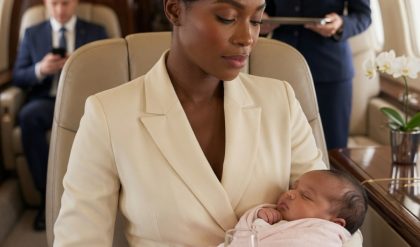
Not concern. Not sympathy. Just judgment wrapped in a perfect airline smile. And in that exact moment, something deep inside me turned dangerously still. My name is Michelle Carter, and I had spent years mastering the art of silence. I sat perfectly composed in my ivory blazer, diamond bracelet glimmering beneath the cabin lights, while my six-month-old daughter trembled against my chest. Every strand of my hair was pinned neatly into place because discipline had always been my shield. But beneath that calm exterior, humiliation spread through me like fire crawling under ice.
The flight had been delayed nearly an hour on the runway. Passengers were already restless, annoyed, and impatient. And my daughter’s feeding time had passed twenty minutes earlier. All I asked for was hot water to warm her formula. One simple request—the kind any decent airline should have handled in seconds. Instead, the attendant stared at the bottle in my hand like I had handed her trash.
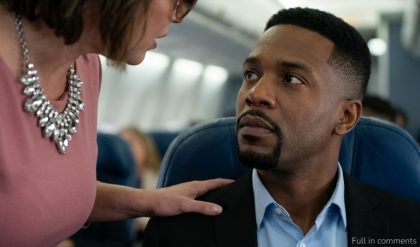
“Ma’am, we are not providing special accommodations during boarding delays,” she announced loudly enough for nearby passengers to hear. Several heads immediately turned toward me. I explained softly that feeding an infant was not a luxury request; it was basic care for a hungry child. But her smile tightened instantly, sharp and fake. Without warning, she snatched the bottle from my hand and slammed it down between us hard enough to rattle the glasses nearby. My daughter burst into louder sobs, and suddenly, phones began rising around the cabin like weapons.
Within seconds, I could feel dozens of eyes watching me like a public spectacle. Someone whispered, “People pay too much for first class to deal with this.” Another voice muttered, “Why bring babies on flights anyway?” Each word landed harder than the last. The attendant crossed her arms and snapped, “You need to calm your child immediately. Other passengers paid for comfort.” I looked up slowly, rocking my daughter. “So did I,” I answered quietly.
Her eyes flicked toward my bracelet, my earrings, my polished clothes, and then back to my face with something almost resentful. “Money doesn’t excuse disruptive behavior,” she replied coldly. Nobody defended me. Nobody offered help. They only kept recording. My daughter’s tiny fists pressed against my blazer, crying from hunger. The untouched formula bottle sat on the tray table like evidence in a courtroom. I could have told her exactly who I was, but I didn’t. I needed to see how far this would go.
What nobody in that cabin knew was that I wasn’t traveling for vacation. I was heading toward the most important corporate launch of my career. For fourteen months, I had led the development of a revolutionary family-travel policy designed to guarantee dignity for parents. My signature sat at the bottom of every final approval document. I wasn’t just a passenger; I was the executive sponsor overseeing the entire airline initiative. But to them, I was only a Black mother with a crying baby making people uncomfortable.
Then, the cabin lights dimmed. A soft electronic chime rang. Every screen on the plane flickered to life at once: A MESSAGE FROM OUR CEO. The flight attendant stiffened as the CEO appeared on every monitor. “Today marks a historic moment,” he began proudly. “This initiative was created under the leadership of a remarkable woman—a leader whose vision is transforming the future of travel.”
The screen behind him faded to black, and suddenly, my own face appeared on every single monitor in the cabin. The entire plane froze. Phones slipped downward. Mouths fell open. The attendant’s face drained of color as passengers stared from the screens, directly back at me in seat 1B. “Please join us in thanking Michelle Carter,” the CEO said, “the woman responsible for changing this airline forever.”
PART 2
The cabin fell into a silence so profound it felt as though the oxygen had been sucked out of the room. Every pair of eyes—the man with the camera, the woman who had muttered about “disruptive behavior,” and the flight attendant—snapped toward me. They weren’t looking at a “nuisance” anymore; they were looking at the woman whose name was on their paychecks and whose policies now dictated every aspect of their service.
The flight attendant, still holding my formula bottle, looked like she wanted to evaporate. Her hand, which had been so aggressive just moments ago, began to tremble. She looked from the screen, where my professional headshot was displayed in high definition, to me, sitting in 1B with a tear-streaked infant on my lap. The transition from “disruptive passenger” to “executive leader” was too much for her to process.
I didn’t smile. I didn’t gloat. I simply held out my hand. “The bottle,” I said, my voice cutting through the silence like a scalpel.
She flinched, almost dropping it. As she placed it back on the tray table, her fingers brushed my blazer—the same blazer she had treated as a costume earlier. “I… Ms. Carter… I had no idea. The policy, it was just… I thought…”
“You thought I was a stereotype,” I finished for her, my tone devoid of anger but heavy with a weight that made her step back. “You didn’t see a mother. You saw an inconvenience. You forgot that your job, regardless of the policy, is to provide service, not judgment.”
The man across the aisle, who had been the first to lift his phone, looked down at his lap, desperately trying to shield his screen from view. The recording he had been so eager to post was now the most dangerous thing in his possession. He knew that if that footage hit social media, he wouldn’t be the one going viral for an “annoying passenger”—he would be the one exposed as part of an airline’s failure.
I stood up, the movement effortless and fluid. I didn’t look at the passengers; I looked directly at the flight attendant. “When we land in New York, I expect a full report on why a simple request for warm water was treated as a security threat,” I said, loud enough for the Captain—who had just stepped out of the cockpit—to hear.
The Captain’s face turned the color of ash as he realized the woman he had just ignored during boarding was the very person he was scheduled to brief upon landing. He rushed over, his cap in his hand. “Ms. Carter! Please, accept our deepest apologies. We will handle this situation immediately.”
I turned my back on them and sat down, pulling my daughter close. As I began to feed her, the cabin was a tomb. No one moved. No one spoke. The screens remained on my face for the duration of the flight, a silent, flickering reminder that dignity is not a privilege to be granted by airline staff—it is a standard to be demanded.
The flight didn’t feel like a journey to a corporate launch anymore. It felt like the beginning of a reckoning. And as the plane finally began its descent, I realized that I hadn’t just changed the airline’s policy; I had changed the way every person in that cabin would see a mother from that day forward. They wouldn’t just see a crying baby; they would see the woman who had the power to change their world.