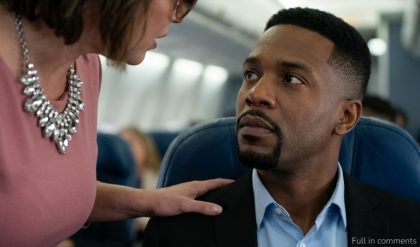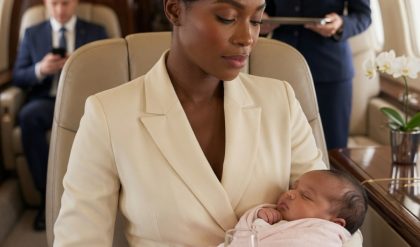
The formula bottle slammed onto the tray table with a crack so sharp that conversations across first class died instantly. Even the soft engine hum seemed to disappear beneath my baby’s frightened cries. Then the flight attendant leaned close enough for me to feel her cold breath and whispered, “Your baby is not our responsibility.”
Not concern. Not sympathy. Just judgment wrapped in a perfect airline smile. And in that exact moment, something deep inside me turned dangerously still. My name is Michelle Carter, and I had spent years mastering the art of silence. I sat perfectly composed in my ivory blazer, diamond bracelet glimmering beneath the cabin lights, while my six-month-old daughter trembled against my chest. Every strand of my hair was pinned neatly into place because discipline had always been my shield. But beneath that calm exterior, humiliation spread through me like fire crawling under ice.
The flight had been delayed nearly an hour on the runway. Passengers were restless, annoyed, impatient. My daughter’s feeding time had passed twenty minutes earlier. All I asked for was hot water to warm her formula. One simple request—the kind any decent airline should have handled in seconds. Instead, the attendant stared at the bottle in my hand like I had handed her trash. “Ma’am, we are not providing special accommodations during boarding delays,” she announced loudly enough for nearby passengers to hear.
Several heads turned toward me. I explained softly that feeding an infant was not a luxury request; it was basic care. But her smile tightened, sharp and fake. Without warning, she snatched the bottle from my hand and slammed it down between us. My daughter burst into louder sobs. Suddenly, phones began rising around the cabin like weapons. Someone whispered, “People pay too much for first class to deal with this.” Another muttered, “Why bring babies on flights anyway?”
The attendant crossed her arms and stood over me with visible irritation. “You need to calm your child immediately,” she snapped. “Other passengers paid for comfort in this cabin.” I looked up slowly while rocking my daughter. “So did I,” I answered quietly. Her eyes flicked toward my jewelry, my clothes, then back to my face with something almost resentful. “Money doesn’t excuse disruptive behavior,” she replied coldly.
What nobody in that cabin knew was that I wasn’t traveling for vacation. I was heading toward the most important corporate launch of my career. For fourteen months, I had led the development of a revolutionary family-travel policy—policies for delays, for feeding, for guaranteeing dignity instead of humiliation. My signature sat at the bottom of every approval document. I was the executive sponsor overseeing the entire initiative being announced that day. But to them, I was just a Black mother with a crying baby.
Then, the cabin lights dimmed. A soft electronic chime rang throughout first class. Every screen on the plane flickered to life at once. A MESSAGE FROM OUR CEO. The flight attendant stiffened. The CEO appeared on every monitor. “Today marks a historic moment for our airline,” he began proudly. “We are honoring a commitment to families traveling with children. This initiative was created under the leadership of a remarkable woman—a leader whose vision is transforming the future of travel.”
The image changed. Suddenly, my own face appeared on every single screen. The entire plane froze. Phones slipped downward. Mouths fell open. The attendant’s face drained of color as passengers stared from the screens… directly back at me sitting in seat 1B. And before anyone could speak, the CEO said, “Please join us in thanking Michelle Carter, the woman responsible for changing this airline forever.”
PART 2
The silence that blanketed the cabin was more suffocating than my daughter’s cries had been minutes earlier. The phones, which had been recording me like a spectacle, were now lowered, feeling suddenly heavy and hot. The man across the aisle, who had muttered about the “disruption,” stared at the screen and then back at me in utter disbelief.
The flight attendant, who had been standing with such cold authority, looked as if she had been frozen in time. The water glass in her hand rattled against the tray, a sharp, rhythmic sound of nerves. She was as pale as her uniform. I stood up slowly, cradling my daughter. I didn’t rush. I didn’t shout. I simply adjusted my blazer and let my gaze sweep across the cabin.
“I believe,” I said, my voice steady but sharp as a razor, “that the policy I spent over a year developing was specifically designed to prevent situations exactly like this one. It is deeply unfortunate that my own airline’s flight was the first to witness such a failure in implementation.”
The attendant stammered, her lips trembling, “I… I didn’t know… Ms. Carter… I was just following…”
“You were following your own prejudice, not the airline’s protocol,” I interrupted, leaving no room for excuses.
Just then, the captain emerged from the cockpit, looking worried after the announcement. He saw me, saw the screens, and immediately understood the gravity of the situation. He walked over and bowed respectfully in front of the entire first-class cabin.
“Ms. Carter, on behalf of the entire airline, please accept our deepest apologies for this unacceptable experience. This will be handled with the utmost severity immediately upon landing.”
I gave a curt nod, feeling no sense of triumph. For me, victory wasn’t about getting someone fired or shaming the passengers; it was about proving that kindness should never be contingent on status. The rest of the flight was dead silent. The attendant was relieved of her duties in the cabin immediately. In her place, the other passengers—who had just moments ago viewed me as an inconvenience—now vied to offer napkins, warm water, and toys for my daughter. The hypocrisy was blatant, but it was a familiar reality I had long ago learned to navigate.
When the plane landed in New York, I stepped out to face a swarm of media waiting for the official launch. I was still Michelle Carter—composed, professional, and poised. But in my bag, alongside my official documents, I carried a small lesson for myself: Never judge a book by its cover, and never judge a mother by her child’s tears. Because sometimes, the person sitting quietly in the corner is the one holding the keys to change the world.